
This is a translation of an interview published in a Sri Lankan news site. The original Sinhala interview can be read here.
"I despise latecomers, even if they are directors of my own board. It was a policy that I implemented even at Brandix. I kept a glass box on the boardroom table and any director who was late had to put in one thousand rupees as a fine. Once or twice was enough, they got the message and was on time there after..."
Q: Who is inside this giant called Ken Balendara?
A: A simple, happy man with a smile on his face. A man who does what he thinks is right. A man who works hard and a kind man looks after fellow workers and colleagues.

Q: What are you engaged in right now?
A: Large corporations and banks keep inviting me to join their boards. However, I have stopped working for pay. Now I only work for the Ministry of Vocational Training and Skills Development. Vocational training is very important to a country's development.
Q: You are a corporate man. Your expertise in business management. Why did you choose vocational training?
A: Mostly for self-satisfaction. If you look at Sri Lanka, there are over one million job vacancies unfilled in areas such as construction. We don't have enough trained and skilled worker and we have to bring construction workers from overseas like China and India. At the same time, thousands of young, capable men are driving three wheelers and getting old without contributing to the national development. There is a tremendous demand for skilled labour all over the world. I got into vocational training to see whether we could make our young men into productive, skilled workers who could get good paying jobs and contribute to national economy.
"Organisations do not need bosses. What they need are capable, knowledgeable leaders."
Q: You are a visionary leader. Can you explain how you inculcated those virtues into your followers?
A: Best example I could cite is the current Chairman of John Keells, Suantha Ratnayake and former deputy chairman Ajith Gunawardene. These were members of a team I created called the "2020 Team" They were a group of young, talented and capable executives who worked with me. I groomed them for leadership of JKH. Susantha and Ajith were chosen for their ability to take responsibility and ownership. They were fearless in expressing their opinions and even did not hesitate to criticize the board of directors. However, they were extremely committed and focused on the company and its vision. They were excellent team players. These are qualities that are needed in a visionary leader.
2020 Team had a lot of work. They had the responsibility to identify young cable people and bring them into the team. They groomed these young executives into playing larger roles within the company. As a result, there were a steady stream of young, capable blood to take up leadership positions in the future.
Q: What is your advice on being a good leader?
A: A leader has act like an iron fist covered with a velvet glove. He/she should be kind and caring but should be tough when it is needed. What is more important to an effective leader is the outcome of any effort or endeavour. If the outcome is marginal or null, it would a waste of time, effort and probably shareholder's capital . A leader should be constantly thinking about how to meet and exceed organisational goals and objectives and how to ensure the excellence of their product or service.
At the same time, it is really important for a leader to make sure that all his/her employees have bought into the vision. They must believe the vision and trust that the leader could guide them towards realizing that vision. Another important thing is that he or she should live by the discipline and other standard expected from the employees.

Q: Can you elaborate on things a good leader should not do?
A: When you deal with your employees, never say things that you do not mean. Never utter things you cannot do or give false hope. You should always speak the truth and say things that makes sense. Never lie to your employees or mislead them. At the same time a good leader is never full of himself or herself.
If a leader at least cannot smile with people who work for them, they become detached and distant. A leader should not create enemies unnecessarily. They should avoid believing tale carriers and if they do, they might end up losing best employees. Another important quality of a good leader is never to have unnecessary and compromising liaisons with the opposite sex. This is especially true for male leaders. They must never have inappropriate dealings with females and should never allow themselves to be manipulated by them. If that happens not only the leader will be destroyed, the organisation would also go into decline.
Q: Can you name a few critical factors that lead to organisational growth?
A: The team leader of that organisation should be a great player. The organisation should not depend too much on elderly directors and must make room for young blood and give them opportunities. The leader must be able to espouse good ideas from young, talented executives and make them happen. Organisations do not need bosses. What they need are capable, knowledgeable leaders.
Q: Coming to your early career, what was your first job?
A: My first job was as the keeper of the Hapugastenne Estate belonging to Finlays. I used to play a lot of rugby those days and the European General Manager of Finlays was a regular spectator. He is the one who gave me an opportunity to join Finlays. I spent seven years among the tea and rubber plantations of Finlays. I learnt a lot of things during my time there. Some of the most valuable skills were time management and fluency in English.
Q: What would you consider as the "Turning Point" of your life?
A: Becoming the first Sri Lankan chairman of John Keells. I was the first local man after Mr. Bostock and Mr. Blacker who were white Europeans.
The position of tea broker at John Keells was the one and only job that I applied after leaving Finlays. After that, everything came to me because of my commitment and performance. I created my own value system and lived by it. All the other positions I have got including the chairmanship of JKH were the result of my performance and my values.
Q: It is often said that you were a happy and fulfilled person thorough-out your corporate career. Could you share your secret?
A: Well, I could say two things contributed to that most. One was that I studied at Royal College. Second is that I played rugby. We had excellent teachers at Royal who taught us discipline and the value of hard work. The school and family environment turned us into good, honest, hardworking men. The other is the temperament I got by playing a highly competitive sport like rugby. Rugby taught me discipline, competitiveness, stamina, the value of teamwork and working according to a plan as well as how to pick myself up even after a crushing defeat and move on and try again. These I believe helped in my corporate life to be happy and content. It could also be that my "stars" were aligned quite helpfully, so to speak.
Q: What would you consider as the most important change you did at John Keells?
A: One is creating the "2020 Team" concept to groom young leaders. The other is increasing female participation at corporate leadership including at board level. That brought in excellent female leaders such as Anushiya Kumaraswami and Rajee Gunawardene to the JKH board.
Q: Do you still get invitations from the corporate world to join them?
A: Yes, even from overseas companies. After retiring from JKH, I joined a few multinationals as the non-executive chairman or as a director. However, I do not see any point in those positions as decisions are taken at the parent company overseas and we are pushed to implement them. However, they paid me very well for being there. That is not something I am comfortable with. I don't want to get paid for doing nothing. So I resigned from all those positions.
Q: Would you agree if I say you managed to do great things at companies that used your talent and expertise?
A: Well if I did such things, it would be due to a pragmatic vision implemented by team work. Being a practical man is more important than anything to a corporate leader. Such an approach will help you to achieve your goals.
Q: What if I say that there is a limit that a senior executive can get down to? How far should a chairman or a corporate leader go in the name of being practical?
A: Let me answer that with a story. At that time I was the Chairman of the Walker's Tours of JKH group. We handled inbound tourists of large European tour operators. One day I got a call from the airport. Apparently there was a disturbance. The caller told me that an organised group at the airport are loading the luggage of tourists by force to transit buses and demanding money from our people at the airport. I went to the airport in time for the next flight of our tourists and I, the chairman of Walker's Tours, took the bags of our inbound tourists and load them into the bus myself. That made headline news the next day with photos of me carrying luggage and the harassment stopped. That's my way and my style.
Q: Can you name a few corporate leaders who inspired you?
A: Mr. Sepala Illangakoon of Hapugastenne Estate who was my first boss. Next, Messers. Mark Bostock and David Blacker of John Keells. They had exceptional qualities which I absorbed into my own life and I tried to infuse those qualities into my followers.
Q: Can you tell me how those qualities made you who you are?
A: At one time during President Chandrika Kumarathunge's administration, I was appointed as the non executive Chairman of the Bank of Ceylon, as the Chairman of the Exchange Commission and as the Chairman of the Sri Lanka Insurance Board. I had three titles, three offices, three secretaries, three cars and was offered three salaries by the government. I did not take a cent or even a car. I worked all three jobs for free because it was government service. That was my condition in accepting those positions then and it is same now. I do not take any money from the services I render to the government even now. That is who I am and those qualities I learned from the people who inspired me.
Q: What is your management style?
A: My management style is not something I learned at the university. I dont have a management degree but at John Keells I managed about 20,000 people. My style is to work closely with employees at all levels in the hierarchy.I don't follow a class system and I don't show attitude.
Q: Did your friendly management style worked at all times?
A: Well, not only at JKH but even at Bank of Ceylon where I was the non executive Chairman of the Board, I did not allow any director who is late to enter the boardroom. Even at Brandix I kept a glass box on the boardroom table and late comers had to put a thousand rupee note into that box as a fine. When someone is late for a meeting, it means that man hours of all the others are wasted. That is unacceptable. It is not good for an organisation.
Q: Brandix recently dedicated one of their ultra-modern office complexes to you?
A: Yes, after retiring from JKH, Brandix invited me to be their Chairman of the board. I worked with them for ten years. They dedicated that building to my name in appreciation of the growth and development Brandix achieved during that time and for creating a management team with vision. Even today, Brandix is going forward with some of the concepts I developed while there. It is a great satisfaction for me.
Q: About your childhood, can you share some fond memories?
A: When I was small, we lived small rented house at 25th Lane, Kollupitiya. Behind our house, which is where the Liberty Plaza shopping complex is now, there were a lot of shanties. There were a lot of kids and we played with those kids. We played cricket and rode bicycles on a small gravel road which is now the Duplication road. When ever I pass Liberty Plaza, those wonderful memories come alive again.
Q: How did you go to school?
A: I went to Royal, which was a fifteen minute walk from the Duplication Road. Most days we walked. Once in a while we took a rickshaw. There was a photo studio near our house called "John & Company". The gentleman who owned it had a car and gave us a lift sometimes.
Q: What was your connection to Jaffna.
A: I was born in Jaffna, at Inuvil Hospital. Grandfather and Grandmother are from Jaffna. My mother went to Jaffna when she gave birth to my brothers and sisters. During school holidays my father would take all of us to Jaffna using his railway warrant. So we spent the entire school holiday with our cousins in Jaffna.
Q: Were you a bright child during schooling years?
A: Well I was better in sports than studies. Everyday at 4.30 in the morning my father would wake us up saying "study....study...study..". I usually turned to the other side and slept again. For O'Levels I got five credit passes. We didn't have A Levels then. We had university entrance exams. I sat for the medical college entrance exams and failed.
Q: What were your childhood dreams?
A: My parents wanted me to be a doctor. I wanted to play rugby for the Sri Lanka national team. I played for the Royal team in 1957, 58, 59 and 1960. The best rugby I ever played was when I played for the Bradby Shield and for the Ceylon Barbarian's club. When I left school, I was the vice captain of the Royal Team.
Q: Your life as child, was there a lot of hardships?
A: Yes of course, but for Jaffna Tamil people, surviving hardships and frugal living is not new. Its in our blood. My father who worked in the Colombo Municipal Council had a salary of rupees seven hundred and fifty. There for five kids and we lived in a rented house. My mother did not work. Seven of us lived for a month with my fathers salary. So we had simple food, simple clothing and frugal lifestyle.
Q: Did you wish you had a better life as a child?
A: Not really. We managed and made do as we could and we were happy. Once my elder brother and I got an invitation for a big wedding reception at Grand Oriental Hotel. My brother had a suit and I did not. So what did we do? My brother went first, greeted the couple, ate quickly and came back. When he returned, I put on his suit and went. That's how we managed.
Q: Did you ever thought of starting on your own? Why did person of your talents ended up working for others?
A: Apart from Finlays where I started my career, every where I worked from John Keells to Walkers Tours, Chevron, Ceylon Tobacco, Brandix, I was in high positions and looked after well. They paid me well and made my life very comfortable. I have been to about 30 countries and when I traveled, they made sure that I traveled first class. I have enjoyed life well. So what more would I want? I have never thought of starting a business on my own.
Q: Did you ever thought of starting on your own? Why did person of your talents ended up working for others?
A: Apart from Finlays where I started my career, every where I worked from John Keells to Walkers Tours, Chevron, Ceylon Tobacco, Brandix, I was in high positions and looked after well. They paid me well and made my life very comfortable. I have been to about 30 countries and when I traveled, they made sure that I traveled first class. I have enjoyed life well. So what more would I want? I have never thought of starting a business on my own.
Q: The sportsman in you?
A: Still there.... I play golf at least twice a week. Visits the gym at about four times a week. So the sportsman in me is alive and well. I am 76 now, but I don't feel that old. My wife wants me to start Yoga...
A: Still there.... I play golf at least twice a week. Visits the gym at about four times a week. So the sportsman in me is alive and well. I am 76 now, but I don't feel that old. My wife wants me to start Yoga...
Q: About your wife?
A: She is Swiree. She is Sinhala Buddhist and I am Tamil Hindu. I met her when I was working at Hapugastanne Estate. She was a doctor at the Ratnapura hospital. We started dating, fell in love and married. We had the kovil ceremony as per the Hindu traditions and poruwa ceremony as per the Buddhist tradition. Once we had children she stopped practicing medicine and decided to be a full time mother and wife.
Q: Your thoughts on Astrology?
A: Parents believed a lot. I am Sagittarius. According to astrologers, I would die when I am 81... so I am waiting (laughing)...
A: She is Swiree. She is Sinhala Buddhist and I am Tamil Hindu. I met her when I was working at Hapugastanne Estate. She was a doctor at the Ratnapura hospital. We started dating, fell in love and married. We had the kovil ceremony as per the Hindu traditions and poruwa ceremony as per the Buddhist tradition. Once we had children she stopped practicing medicine and decided to be a full time mother and wife.
Q: Your thoughts on Astrology?
A: Parents believed a lot. I am Sagittarius. According to astrologers, I would die when I am 81... so I am waiting (laughing)...
Q: How about Ken Balendra as a father?
A: My son, Krishan Balendra is an Executive Director at JKH, my daughter Natasha Balendra was the Chairperson of National Child Protection Authority until April 2017. They have five children... my grand children. These five rascals (laughing...) are my best friends now...
A: My son, Krishan Balendra is an Executive Director at JKH, my daughter Natasha Balendra was the Chairperson of National Child Protection Authority until April 2017. They have five children... my grand children. These five rascals (laughing...) are my best friends now...
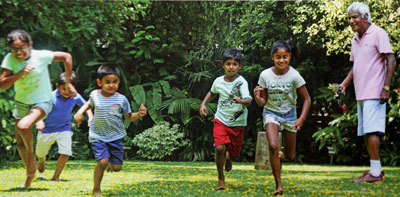 |
| Ken Balendra with his five grandchildren (C) Sunday Times |
Copyright Notice: This interview was first published in Sinhala on aperata.net. Tanslated to English for Colombo Commerce Blog (CCB) by the Editor (CCB). All copyrights of the text and images belong to their respective owners. Reproduced here for educational purposes.
No comments:
Post a Comment