
Last September (2017), market research group Kantar LMRB unveiled the latest Top Ten FMCG Brands for the Sri Lankan market. According to Kantar LMRB Chief Executive Himalee Madurasinghe, the findings summarized 1.4 billion shopper decisions from 5 million households and included 400 brands. The results were not surprising at all. Most of the top ten brands (a whopping 7 out of 10) were from well established multinationals with a knack for localisation. Deep localisation and adaptation has worked so well for these brands that most consumers regard them as Sri Lankan brands rather than billion dollar multinational brands.
There were four from Unilever, namely Sunlight, Lifebuoy, Vim and Signal. Two from Nestle, the teenager/uni-student staple diet Maggi and nutritional drink Nestomalt. It was a surprise that Milo (Nestle) and Lux (Unilever) didn't make the cut. Other MNC brand that made the top ten was Anchor, the flagship brand of New Zealand based Fonterra. Only Sri Lankan homegrown brands to make the top ten were Munchee, which was rated as number one brand in Sri Lanka for 2017, consumer foods brand Maliban which came in at number 3 and Fonterra's local milk powder brand Ratthi.
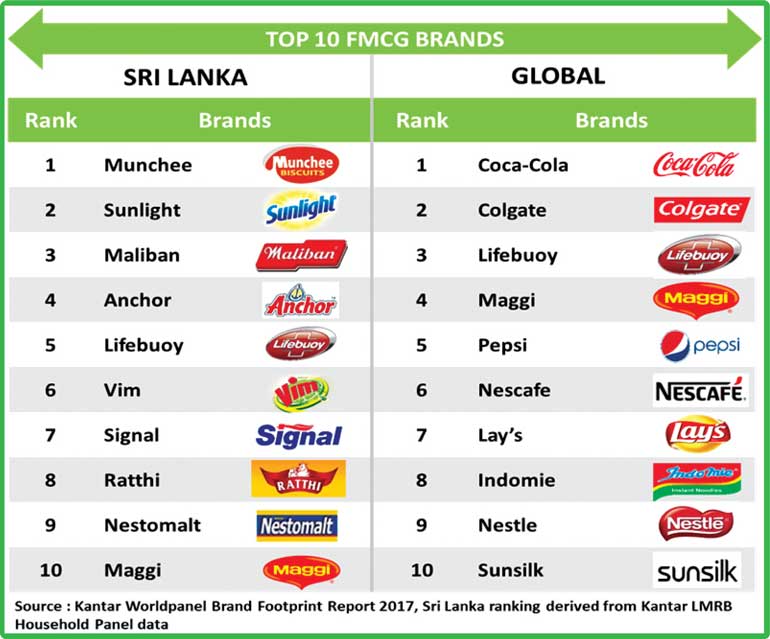
It is sad that brands such as Dilmah (Tea), Elephant House & Krest (JKH), consumer brands from Hemas (Clogard, Dandex etc), Sunshine Holdings (Zesta) or Richard Peiris (Arpico, St Clair) did not make the top ten list. While the writer does not have empirical research data, conventional wisdom says that MNCs like Unilever and Nestle has more financial capital and human capital to out-compete local brands and come out at the top.
However, this is not necessarily a bad thing. While they are multinationals, these brands are run by local managers and the competition they bring make home-grown brands better and more innovative. In addition, MNCs like Unilever, Nestle, Coca Cola and Fonterra are excellent training grounds for local marketing talent. Many top executives in the FMCG and Consumer sectors in Sri Lanka have cut their marketing teeth at one of those top multinationals. Knowledge and skills they gain at these MNCs in the formative years of their careers are later transferred to home-grown brands when the executives look for higher positions and better prospects at well paying national companies. Sri Lankan FMCG industry is vibrant and challenging thanks to the MNC brands.
The 2018 top ten FMCG list is not out yet, but 2018 Brand Finance top 100 brands for Sri Lanka had some surprises. For an example, Lion (Lion Brewery Ceylon) did not make the 2017 top ten FMCG list, but made it to the number 9 of the most valuable brands in Sri Lanka. Of course these are two different surveys created using different metrics, but considering the national liquor consumption statistics, Lion should be one of the favorite Sri Lankan brands.
FMCG : Looking to the future
 |
| Image copyright belongs to NDB Securities : Used here for educational purposes |
According to the NDB Securities FMCG sector report 2017, The Fast Moving Consumer Goods (FMCG) is a significant contributor to the economy. FMCG sector consists of FB & T (Food and non-alcoholic Beverages (F&B), alcoholic beverages and tobacco) together with wholesale and retail trade. The sector contributes to almost 30.0% of GDP and close to 20% of the overall employment in the country.
The sector looked very promising and grew in leaps and bounds after the end of the civil war in 2009. However, the growth has slowed down since 2015. The political uncertainty prevailing after the election of the new government and some policy reversals, confusing taxation regimes coupled with currency depreciation, uptick in inflation as well as increasing interest rate environment is damaging consumer sentiment as well as investor confidence in the sector. A good example is the cancellation of planned investments by Hemas Holdings. Hemas raised 4.1 billion rupees in a rights issue for a planned expansion of its FMCG operations. However, with the recent developments and the slowing down of the sector, the company shelved those plans and instead used that block of cash to buy out Atlas Axillia, the leading stationary brand in order to reduce its exposure to FMCG sector, increase cash flow and revenue from its consumer business.
 |
| Image copyright belongs to NDB Securities : Used here for educational purposes |
However, all is not gloom and doom. According to research reports such as NDB Securities FMCG sector report, the expected compound annual growth rate (CAGR) is about 8% in the next five years. The sector will be worth 1.28 trillion rupees if the growth projections pan out. Near term growth is expected in milk and dairy consumption, poultry consumption and alcohol consumption.

Even-though the interests have been rising since 2016, the country has managed to contain the inflation to a single digit and have been fluctuating between 4% to 8%. While interest rates have an impact on business sentiment, inflation has major effect on the real income of people. According to a report released by the World Bank on April 2018, GDP growth is projected to rebound in 2018 and continue to be around 4.5 percent in the medium term, driven by private consumption and investment. According to World Bank, inflation is expected to stabilize around 5% which is good for FMCG sector.
No comments:
Post a Comment